Definition and types of supernovae
Supernovae are stellar explosions marking the final stage in the life of massive stars. They are classified according to their spectral properties and light curves, which reveal information about their composition and evolution.1
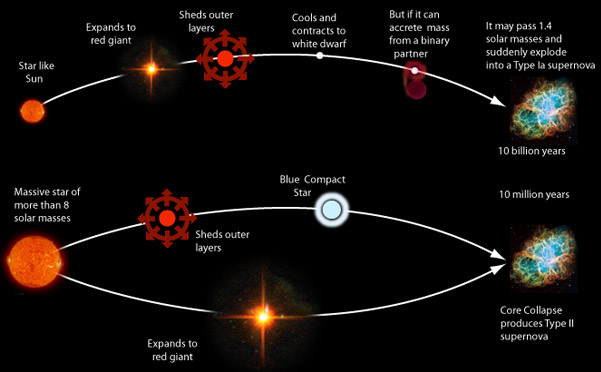
Image: Diagram illustrating the evolutionary paths leading to Type Ia and Type II supernovae.23
Image credit: HyperPhysics / Georgia State University; original authorship of this specific diagram unconfirmed.
Available at: link. Accessed on: 27 Oct. 2025.
If a supernova’s spectrum lacks hydrogen, it is classified as Type I; if hydrogen is detected, it is classified as Type II.2 Type I supernovae are subdivided into Ia, Ib, and Ic, each corresponding to distinct astrophysical scenarios.3
Type Ia supernovae, also known as thermonuclear supernovae, occur in binary systems involving a white dwarf, the dense remnant of a smaller star that has exhausted its nuclear fuel.4 When the white dwarf accretes material from its companion star and reaches 1.44 solar masses – the Chandrasekhar limit – it becomes unstable and explodes.5
Type Ib and Ic supernovae, on the other hand, represent the collapse of massive stars that have lost their outer layers before the explosion. Type Ib retains traces of helium, while Type Ic lacks both hydrogen and helium.6
Type II supernovae, or core-collapse supernovae, occur in stars containing 8 to 200 solar masses.7 These stars burn their nuclear fuel rapidly and end their lives catastrophically when their cores can no longer resist gravitational collapse.8 The outer layers are ejected into space, forming a supernova remnant – an expanding nebula of gas and dust that contributes to the chemical enrichment of the universe.9
Depending on the progenitor’s mass, the collapsed core may leave behind a neutron star or a black hole, regions where gravity is so strong that not even light can escape.10
These explosions can shine for months or even years, sometimes outshining entire galaxies. Many such events were recorded by ancient astronomers – particularly in East Asia – who referred to them as ‘guest stars’.11
Supernovae Through Time
Over the past two millennia, nine supernovae have been historically documented: AD 185, 369, 386, 393, 1006, 1054, 1181, 1572, and 1604.12 Of these, only the explosions between AD 1006 and 1604 have confirmed remnants.13 Identifying a connection between ancient observations and modern remnants allows astronomers to classify the type of explosion and model its evolution.
This research focuses on SN 1006, SN 1054, and SN 1181. SN 1006 was the brightest supernova ever seen with the naked eye.14 SN 1054 produced the Crab Nebula.15 SN 1181 has recently been reexamined in light of new data linking it to the remnant Pa 30.16
The primary framework for these studies was established by Green and Stephenson (2003a),17 who discussed the nine known events and their possible remnants across Chinese, Japanese, Korean, Arabic, and European sources. Their comparative approach remains a cornerstone for research on historical supernovae.
F. R. Stephenson stands as one of the most influential figures in this field. His works from 1971 to 2010 reconstruct observation timelines and analyze cross-cultural records, often in collaboration with D. A. Green.18
In parallel, Bernard R. Goldstein19 offered a seminal study on SN 1006. Further contributions from Rada and Neuhäuser20 and Neuhäuser, Ehrig-Eggert, and Kunitzsch21 extended this understanding with additional Arabic sources, including, respectively, reports from Yemen and Avicenna’s Kitāb al-Shifāʾ.
To better visualize the global scope of these historical records, the following map indicates the approximate regions where the supernovae of AD 1006, 1054, and 1181 were documented. These records originated from distinct cultural and geographical contexts.
Map: Approximate global observation sites of the supernovae between AD 1006 and 1181 (compiled from multiple scholarly sources; approximate locations based on historical sources; modern borders used for reference).
The interdisciplinary nature of supernova studies – blending astronomy, philology and cultural history – continues to reveal how different civilizations interpreted the same celestial events. Some researchers even suggest that rock art in the United States and in Brazil may depict supernovae,22 illustrating that humanity’s enduring fascination with the stars has always been worldwide.
Note: This text is adapted from my thesis (2025), with all sources duly cited.
References
- NATIONAL SCHOOLS’ OBSERVATORY. [n.d.]b. Types of Supernovae. Available at: link. Accessed on 17 Aug. 2024. ↑
- NATIONAL SCHOOLS’ OBSERVATORY. [n.d.]b. ↑
- NATIONAL SCHOOLS’ OBSERVATORY. [n.d.]b. ↑
- NATIONAL SCHOOLS’ OBSERVATORY. [n.d.]a. Stellar Evolution. Available at: link. Accessed on 17 Aug. 2024. ↑
- NATIONAL SCHOOLS’ OBSERVATORY. [n.d.]b. ↑
- NATIONAL SCHOOLS’ OBSERVATORY. [n.d.]b. ↑
- NATIONAL SCHOOLS’ OBSERVATORY. [n.d.]b. ↑
- SOBRINHO, J. L. G. Estrelas: origem, evolução e morte. Formação Contínua de docentes: Introdução à Astronomia (texto de apoio ao módulo 3), pp. 2, 13, Universidade da Madeira (2013).↑
- SWINBURNE. Supernova Remnant. Available at: link. Accessed on: 8 Sep. 2024 ;
DEPARTMENT OF ENERGY. DOE Explains…Supernovae. Available at: link. Accessed on: 8 Sep. 2024.↑ - CLARK, D. H.; STEPHENSON, F. R. The Historical Supernovae. England: Pergamon Press, 1977, p. 2. ↑
- CLARK, D. H.; STEPHENSON, F. R. Which historical new stars were supernovae. Royal Astronomical Society, Quarterly Journal, vol. 17, p. 297, 1976;
GREEN, D. A.; STEPHENSON, F. R. The historical supernovae. In: Supernovae and Gamma-Ray Bursters. Berlin, Heidelberg: Springer Berlin Heidelberg, 2003a. p. 7-19. ↑ - GREEN; STEPHENSON, 2003a, p. 2. ↑
- RITTER, Andreas et al. The Remnant and Origin of the Historical Supernova 1181 AD. The Astrophysical Journal Letters. American Astronomical Society, v. 918, n. 2, p. 1, 2021. ↑
- STEPHENSON, F. R. SN 1006: the brightest supernova. Astronomy & Geophysics, v. 51, n. 5, p. 5.27-5.32, 2010. ↑
- STEPHENSON, F. R.; GREEN, D. A. Was the supernova of AD 1054 reported in European history?. Journal of Astronomical History and Heritage, v. 6, n. 1, p. 46, 2003b. ↑
- RITTER et al. 2021;
SCHAEFER, Bradley E. The path from the Chinese and Japanese observations of supernova 1181 AD, to a Type Iax supernova, to the merger of CO and ONe white dwarfs. Monthly Notices of the Royal Astronomical Society, Oxford, v. 523, n. 3, p. 3885-3904, Aug. 2023. ↑ - GREEN; STEPHENSON, 2003a. ↑
- STEPHENSON, F. R. A suspected supernova in AD 1181. In: International Astronomical Union Colloquium. Cambridge University Press, p. 10-38, 1971;
STEPHENSON, F. R.; GREEN, D. A. The supernova of AD 1181: an update. Astronomy & Geophysics, v. 40, n. 2, p. 2.27-2.28, 1999;
STEPHENSON, F. R.; GREEN, D. A. The SN of AD 1006. In: STEPHENSON, F. R.; GREEN, D. A. Historical Supernovae and their Remnants. Oxford: Oxford University Press, 2002a. p. 150-174;
STEPHENSON, F. R.; GREEN, D. A. The SN of AD 1054. In: STEPHENSON, F. R.; GREEN, D. A. Historical Supernovae and their Remnants. Oxford: Oxford University Press, 2002b. p. 117-149;
STEPHENSON, F. R.; GREEN, D. A. The SN of AD 1181. In: STEPHENSON, F. R.; GREEN, D. A. Historical Supernovae and their Remnants. Oxford: Oxford University Press, 2002c. p. 100-116. ↑ - GOLDSTEIN, Bernard R. Evidence for a supernova of AD 1006. The Astronomical Journal. American Astronomical Society, v. 70, n. 1, p. 105-114, 1965. ↑
- RADA, Wafiq; NEUHÄUSER, Ralph. Supernova SN 1006 in two historic Yemeni reports. Astronomische Nachrichten, v. 336, n. 3, p. 249-257, 2015. ↑
- NEUHÄUSER, R.; EHRIG‐EGGERT, C.; KUNITZSCH, P. An Arabic report about supernova SN 1006 by Ibn Sīnā (Avicenna). Astronomische Nachrichten, v. 332, n. 8, p. 789-795, 2011. ↑
- MILLER, William C. Two prehistoric drawings of possible astronomical significance. Astronomical Society of the Pacific Leaflets, Vol. 7, No. 314, v. 7, p. 105-112, 1955;
THAN, K. Ancient rock art depicts exploding star. Space.com. 5 Jun. 2006. Available at: link. Accessed on: 18 July 2025. ↑ - GEORGIA STATE UNIVERSITY. Supernova Classification. HyperPhysics, Department of Physics and Astronomy. Available at: link. Accessed on: 27 Oct. 2025. ↑