
Possible references to the supernova of AD 1054 have also been proposed in North America, though none can be regarded as secure. Two main groups of evidence have attracted scholarly attention.1 The first consists of cave paintings described by Miller (1955) at White Mesa and Navaho Canyon in Arizona, where a crescent Moon appears beside a circular symbol – an unusual pairing in the local rock-art tradition.2 Miller (1955, p. 105) cautiously noted that interpreting such figures is a “dubious undertaking”, yet their striking similarity suggested to him a possible astronomical significance.3
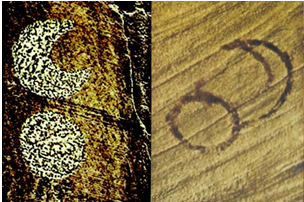
Image: Rock-art panels proposed as possible depictions of the supernova of AD 1054, showing crescent-Moon motifs paired with star-like circles. The images correspond to the sites of Navaho Canyon (left) and White Mesa (right), Arizona.
Image credit: Abt & Fountain (2018) / Zullo Photography. In: COSTA, 2022, p. 49.11
Later scholars, cited by Stephenson and Green (2002b, p. 142), proposed that these images might represent the conjunction of the crescent Moon and the 1054 supernova, since on the morning of 5 July 1054 the Moon passed very close to the position of the ‘guest star’.4 However, the dating of the paintings is broad (between the tenth and twelfth centuries), and only one example shows the crescent in the correct orientation relative to the star.5 Moreover, as Stephenson and Green (2002b, p. 142) stress, the images could equally well represent conjunctions of the Moon with Venus.
A second proposed case comes from a petroglyph at Chaco Canyon (New Mexico), where a crescent Moon appears next to a star-like disk, with a hand symbol above.6 On the same rock face, another carving has been interpreted by some scholars as depicting the core and tail of a comet – possibly Halley’s Comet in 1066 – though this remains uncertain.7
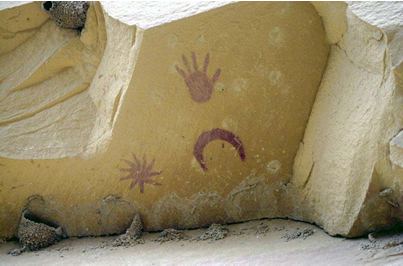
Image: Petroglyph panel at Chaco Canyon, New Mexico, discussed as a possible depiction of a crescent Moon beside a star-like disk.
Image credit: Photograph by Alex Marentes, 6 March 2006. In: COSTA, 2022, p. 48.12
These identifications, while intriguing, remain speculative.8 The chronological uncertainty of the rock art, the limited number of motifs matching the correct lunar orientation, and the plausibility of alternative explanations (such as Venus-Moon conjunctions) prevent firm conclusions.9 As Stephenson and Green (2002b, p. 142) emphasize, outside East Asia the only reliable record of the 1054 supernova remains the testimony of Ibn Buṭlān in Constantinople. Any proposed North American evidence must therefore be treated with extreme caution.10
Note: This text is adapted from my thesis (2025), with all sources duly cited.
References
- MILLER, William C. Two prehistoric drawings of possible astronomical significance. Astronomical Society of the Pacific Leaflets, Vol. 7, No. 314, v. 7, p. 105-112, 1955;
BRANDT, John C.; WILLIAMSON, Ray A. The 1054 supernova and native American rock art. Journal for the History of Astronomy, Archaeoastronomy Supplement, Vol. 10, p. S1, v. 10, p. S1, 1979;
AL DALLAL, S.; AZZAM, W. J. A Brief Review of Historical Supernovae. International Journal of Astronomy and Astrophysics, v. 11, n. 1, p. 80, 2021. ↑ - MILLER, 1955, p. 105. ↑
- MILLER, 1955, p. 105. ↑
- STEPHENSON, F. R.; GREEN, D. A. The SN of AD 1054. In: STEPHENSON, F. R.; GREEN, D. A. Historical Supernovae and their Remnants. Oxford: Oxford University Press, 2002b. p. 142. ↑
- STEPHENSON; GREEN, 2002b, p. 142. ↑
- AL DALLAL; AZZAM, 2021, p. 80. ↑
- AL DALLAL; AZZAM, 2021, p. 80. ↑
- STEPHENSON; GREEN, 2002b, p. 142. ↑
- STEPHENSON; GREEN, 2002b, p. 142. ↑
- STEPHENSON; GREEN, 2002b, p. 142. ↑
- COSTA, Felipe Sérvulo Maciel. Interpretações arqueo astronômicas da supernova 1054 no sítio arqueológico Lagoa do Escuro e na Toca dos Astros. Revista Tarairiú, v. 1, n. 19, p. 49, 2022. ↑
- COSTA, 2022, p. 48. ↑