
Evidence from North America regarding the supernova of 1006 remains hypothetical. Scholars have suggested that a rock carving in the White Tanks Regional Park near Phoenix, Arizona, might depict the event. The petroglyph, attributed to the Hohokam culture (ca. AD 500-1100), shows a scorpion-like figure beside a prominent star symbol – a configuration proposed to match the position of the supernova just south of Scorpius in the spring sky of 1006.1
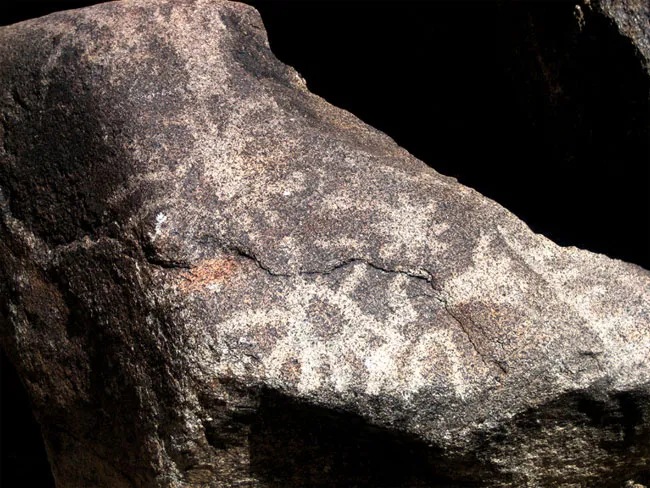
Image: Petroglyph with possible depiction of the supernova of AD 1006 (star symbol, right of center) beside the constellation Scorpius (scorpion symbol, left of center), White Tanks Regional Park, Phoenix, Arizona.
Image credit: John Barentine / Apache Point Observatory.
Caption adapted from: Ker Than, Ancient Rock Art Depicts Exploding Star (2006).
Available at: link. Accessed on: 18 July 2025.
Modern modeling of the sky by John Barentine (Apache Point Observatory, New Mexico) and Gilbert Esquerdo (Planetary Science Institute, Arizona) supports this visual alignment, and if confirmed, the carving would represent the only known observation of SN 1006 from the Americas.2 Barentine has emphasized the potential significance of such a link, noting that any ancient artwork that can be anchored to a specific astronomical year is “extremely valuable.”3
He further remarked that this would suggest Indigenous observers were attentive to celestial change and commemorated extraordinary events in material culture – a reminder that sky-watching traditions extend well beyond literate Old World societies.4
That said, the interpretation stays speculative: petroglyphs are symbolic by nature, and dating them with precision remains challenging. Nonetheless, parallels with another famous rock carving at Peñasco Blanco in Chaco Canyon – long argued to represent the supernova of 1054 – bolster the possibility.5 If the White Tanks image indeed commemorates SN 1006, then the most brilliant stellar event in recorded history was not only seen across the Middle East, Europe and Asia but also etched into the cultural record of ancient North America.
Note: This text is adapted from my thesis (2025), with all sources duly cited.