In the Islamic world, for the supernova of AD 1006, the records are abundant. The Egyptian account stands out for its exceptional observational detail and explicit astrological framing.1 Iraqi and Yemeni2 narratives preserve consistent chronological markers and descriptions of extraordinary brightness over several months. In the western Islamic world (Morocco, perhaps Spain), a later chronicle transmits the memory within an omen-literature framework, emphasising prodigy and divine signification.3 Persia adds Avicenna’s perspective, notable for its unique remarks on colour evolution and scintillation, which stand apart from other Islamic reports.4
Egypt
ʿAlī ibn Riḍwān (Fusṭāṭ/Cairo) embeds the ‘new star’ within the astrological discourse of Ptolemy’s Tetrabiblos, situating the event not merely as a visual phenomenon but as a sign with terrestrial implications. His testimony survives both in Arabic manuscripts and in a 1493 Latin rendering by Aegidius Tebaldinus (Quadripartitum).5
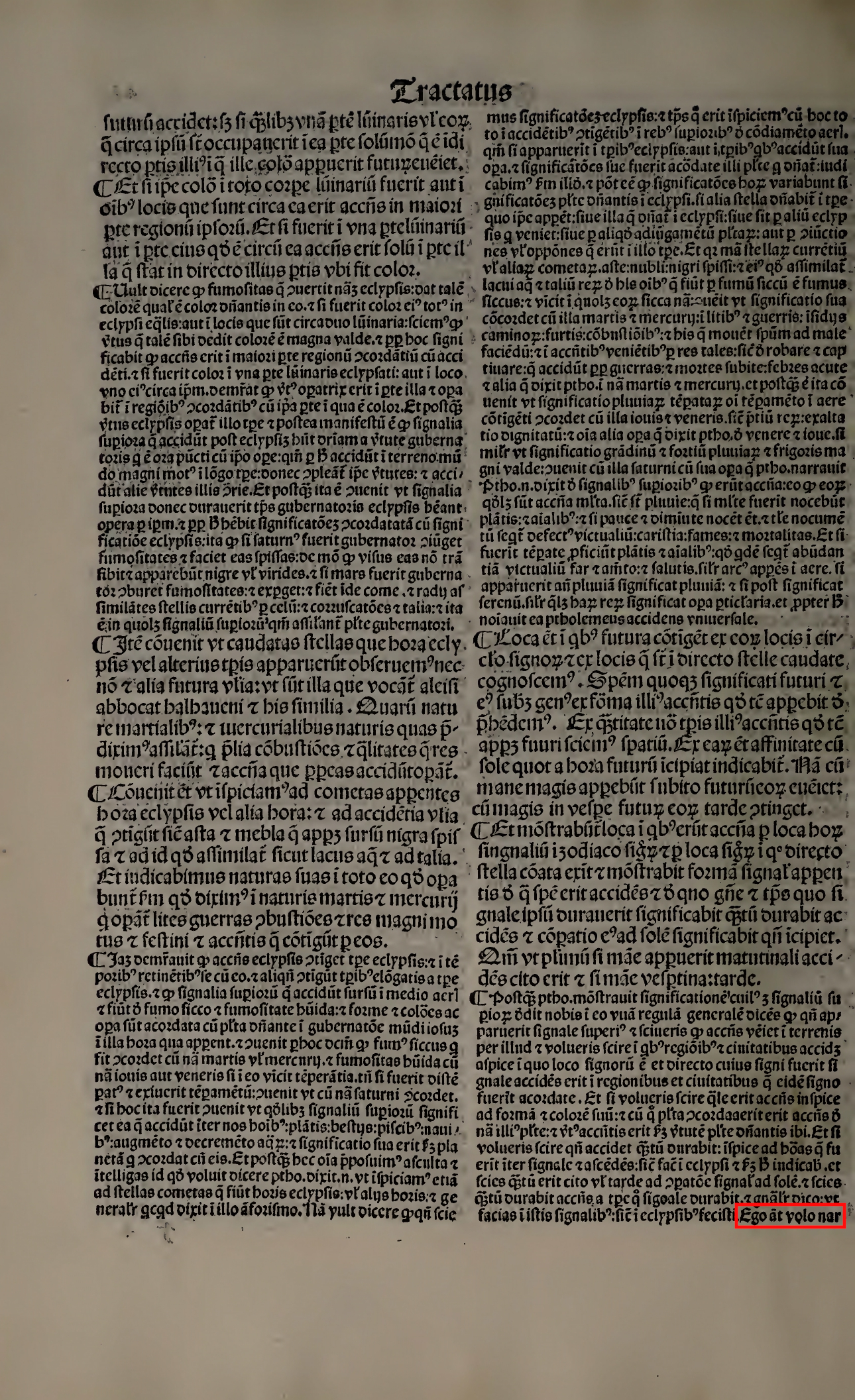
Fol. 46v
Latin transmission of ʿAlī ibn Riḍwān’s testimony on the supernova of AD 1006. This folio contains the opening portion of ʿAlī ibn Riḍwān’s report as incorporated into the astrological tradition transmitted through Ptolemy’s Quadripartitum in late mediaeval Latin scholarship.
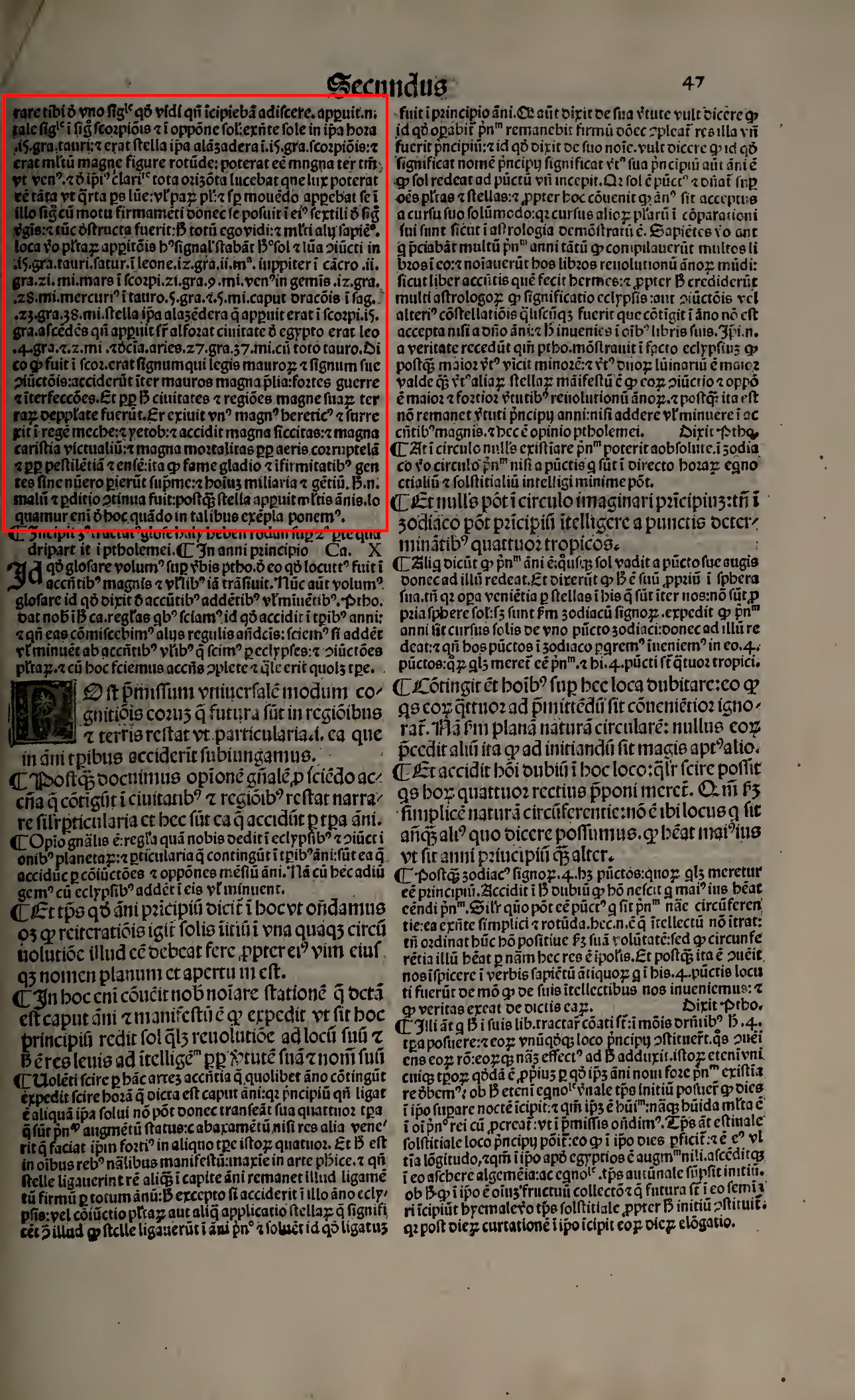
Fol. 47r
Continuation of the Latin text describing the SN 1006 record. This page preserves the subsequent section of ʿAlī ibn Riḍwān’s account, forming part of the extended commentary tradition embedded in the 1493 Venetian edition.
Images: Folios 46v-47r from the 1493 Venetian edition of Liber quadripartiti Ptholomei, preserving the Latin transmission of ʿAlī ibn Riḍwān’s testimony on the supernova of AD 1006.
Image credit: Internet Archive / Boston Public Library.
Source: Liber quadripartiti Ptholomei (1493), Boston Public Library, Rare Books Department.6
The passage referring to ʿAlī ibn Riḍwān is outlined in red.
His account is extremely rich in observational detail: he specifies the star’s appearance at 15° Scorpio, describes it as round and between two and three times the apparent size of Venus, notes its intense scintillation and horizon-illumination, and compares its brightness to roughly a quarter of the Moon’s light. He also records the moment of disappearance through astrological timing – when the Sun reached Virgo – thereby preserving a chronological framework that aligns with modern reconstructions.7 Notably, as Goldstein (1965, p. 106) has demonstrated, ʿAlī employs the rare term nayzak to describe the object – a word of Persian origin meaning ‘short spear’,8 attested only a few times in mediaeval Arabic sources.
ʿAlī ibn Riḍwān — report:
“I will now describe for you a spectacle (athar) that I saw at the beginning of my education (ta’alīm). This spectacle (athar) appeared in the zodiacal sign Scorpio in opposition to the sun, at which time the sun was in the 15th degree of Taurus, and the spectacle (nayzak) in the 15th degree of Scorpio. It was a large nayzak, round in shape, and its size 2 1/2 or 3 times the magnitude of Venus. Its light illuminated the horizon and it twinkled very much. The magnitude of its brightness was a little more than a quarter of the brightness of the moon. It continued to appear and it moved in that zodiacal sign with the motion of the equator (i.e., the daily rotation) until the sun arrived at the zodiacal sign Virgo, in sextile to it [an astrological term meaning that the sun was within two zodiacal signs of the apparition], and it ceased (appearing) all of a sudden (duf’atan wāhidatan). This apparition was also observed at the time by (other) scholars just as I have recorded it.
The positions of the planets when it began to appear were as follows:
Sun and moon: __________Taurus_______15°
Saturn: _________________Leo________ 12;11
Jupiter: ________________Cancer_______11;21
Mars__________________Scorpio_______21;19
[Latin reads: Scorpio 21;9° (21;9° means 21 degrees and 9 minutes]
Venus_________________Gemini_______12;28
Mercury_______________Taurus_______5;11
[Latin reads: Taurus 5;5°]
Lunar (ascending) node: _Sagitarius_____23;28The nayzak came forth in the 15th degree of Scorpio. The ascendant of the conjunction at the time of the appearance of the nayzak, for the horizon of Fusṭāṭ in Egypt, was 4;2° of Leo; and the tenth (house which included most of) Taurus began at Aries 26;27°. [Latin reads: Aries 27;27°. The ascendant is the point of the ecliptic which is rising from the horizon at some given time. The tenth house begins at the upper culmination of the ecliptic and is a portion of the ecliptic which rises in two hours. There are twelve houses in all, starting from the ascendant in the order of the zodiacal signs.]
Scorpio is the sign which indicates calamity (kusüf) for the Muslim community. Therefore, great wars have broken out between Muslims which have destroyed great countries. Thus the Khawārij [a heretical Muslim sect. The reference is to the civil war in Arabia at the time of the Omayyads] went out against the king of the two holy cities (Mecca and Medina) [Latin: mecche et yetob (i.e., yathrib, or Medina)]. Famine, dearth, and pestilence broke out, and many thousands beyond count died by the sword, as well as from dearth and pestilence. At the time when the nayzak appeared, there (again) occurred calamity and destruction which lasted for many years after its appearance; and we examine this for (its) exemplariness.”
(GOLDSTEIN, 1965, p. 105–106)
He explicitly associates the star’s position in Scorpio with calamity for the Muslim community, invoking a long-established astrological tradition in which certain zodiacal signs heralded strife, famine, and political unrest.9 In doing so, he reveals how astronomical description and astrological meaning were not competing frameworks but mutually reinforcing modes of knowledge in mediaeval scholarship.
Iraq
1. Ibn al-Jawzī
Ibn al-Jawzī, in his universal chronicle Kitāb al-Muntaẓam (d. 1200), preserves a note on brightness, direction, and duration, situating a ‘great star’ in relation to the qibla and comparing its radiance to Venus and the Moon:10
Ibn al-Jawzī — report:
“Among the reports for (A.H. 396): There appeared a great star similar to Venus in size and brightness, wavering to the left of the qibla. Its rays on the earth were like the rays of the moon. It appeared on the night (preceding) Friday, the new moon of Shuʿbān, and it remained fixed until the middle of Dhū al-Qaʿda, whereupon it disappeared.”
(GOLDSTEIN, 1965, p. 107)
2. Ibn al-Athīr
Ibn al-Athīr, in his Kitāb al-Kāmil fī al-Taʾrīkh (13th century), repeats and localises this tradition, noting that the star appeared “to the left of the qibla of Iraq” and shone with light like that of the Moon. Although derivative of Ibn al-Jawzī, his account reinforces key observational elements – brightness, fixed position, and a duration of months – demonstrating how the memory of SN 1006 circulated across Islamic historiography:11
Ibn al-Athīr — report:
“In that year (A.H. 396), at the new moon of (the month) Shuʿbān, a large star similar to Venus appeared to the left side of the qibla (i.e., the direction to Mecca) of Iraq. Its rays on the earth were like the rays of the moon, and it remained until the middle of (the month) Dhū al-Qaʿda when it disappeared.”
(GOLDSTEIN, 1965, p. 107)
Yemen
1. Al-Yamanī
Al-Yamanī, in Bahjat al-Zamān fī tārīkh al-Yaman (pre-1342), offers a detailed testimony. He situates the star’s first appearance in mid-Rajab 396 AH, notes its rise shortly after sunset in the east, and compares its brilliance to – or even exceeding – that of Venus. His description of an elongated form with “lines like fingers”, flickering like an object seen through disturbed water, and radiating with sunlight-like intensity preserves vivid visual impressions:12
Al-Yamanī — report:
“On the night of mid-Rajab (or: 15th of Rajab), in the year 396h, a star appeared from the east at half an hour after sunset. It was four times as large as Venus. [It was as large as Venus and rose several times after sunset]. It was not circular, but nearer to an oblong. At its ends, there were lines like fingers. It showed a great turbulence as though it was seen in disturbed water. Its light rays were similar to sunlight. It appeared in the zodiacal sign of Libra in Scorpio and remained unchanged like that. In the night of mid-Ramadan, its light started to decrease and gradually faded away.”
(RADA & NEUHÄUSER, 2015, p. 250)
2. Ibn al-Daybaʿ
Ibn al-Daybaʿ, in Qurrat al-ʿUyūn fī Akhbār al-Yaman al-Maymūn (15th-16th century), preserves a closely parallel version of the Yemeni tradition. Like al-Yamanī, he dates the star to mid-Rajab 396 AH and describes it rising about half an hour after sunset, shining with a brilliance likened to Venus. He repeats the striking imagery of an elongated form with “finger-like” rays and a turbulent, shimmering appearance “as though seen in disturbed water”, before noting its gradual fading around mid-Ramadan. Although composed centuries later and likely derivative, his narrative confirms the persistence and stability of key observational motifs:13
Ibn al-Daybaʿ — report:
“In the year 396h, on the night of mid-Rajab, a star like Venus appeared. It regularly rose half an hour after sunset. It was not round, but rather was elongated; at its edges were [lines like] fingers. It showed great turbulence as though (reflected) in disturbed water. Its light rays were similar to the rays of the Sun. It appeared in the location of al-Ghafr in the sign of Libra. It remained unchanged until the night of mid-Ramadan. Then, its light diminished and it gradually faded away.”
(RADA & NEUHÄUSER, 2015, p. 250)
Morocco (perhaps Spain)
Annales Regum Mauritaniae (comp. AH 726 / ca. AD 1326; ed. Tornberg, 1843) transmit the memory of the star through a later Maghribi lens, also employing the term nayzak14 and an omen-literature frame. The chronicler describes a “great, wondrous star” whose brilliance was “beyond doubt” and links its appearance to divine judgement, emphasising celestial signs as heralds of earthly upheaval. Though derivative and compiled three centuries after the event, the chronicle preserves key motifs – extraordinary brightness, prolonged visibility, and the interpretive habit of reading the heavens as communicative:15
Annales Regum Mauritaniae — report:
“In the year 396 [A.H.] a great [variant: wondrous] star, a comet, appeared which was very brilliant [variant: most frightening], (whose unrest hindered attentive observations; yet its appearance was beyond doubt). It was one nayzak of the twelve [adding the word ‘ashar to the Arabic text as does Tornberg], which the ancients mentioned. Their scholars observed it for a long time and they argued that a star could only appear as a judgment for the world, upon which God has resolved but God knows His secrets best. (It began to appear in the beginning of Shu’ban [3]96 [A.H.]. Its first appearance took place before (its) setting whereupon it went backwards until it rose (the following) night. It lasted for a period of six months and then disappeared. In that year there were strong winds, bursts of lightning, and shattering thunder, without rain.)”
(GOLDSTEIN, 1965, p. 108)
Persia
Avicenna (Ibn Sīnā), in Kitāb al-Shifāʾ (ca. 1013–1023), records the event in a philosophical and natural-scientific context, referring to a “form of a star among the stars” that remained visible for nearly three months. His brief notice includes strikingly original remarks: the object first appeared with a darker, greenish tint, then “threw out sparks”, and later became increasingly white before fading – a sequence that suggests both scintillation and colour evolution. Although his dating (397 AH) stands one year later than the other Islamic reports, the content aligns closely with independent observations, and the testimony’s conceptual framing reveals a scholar grappling with a phenomenon that defied existing categories while still embedding it within Aristotelian natural philosophy:16
Avicenna (Ibn Sīnā) — report:
“It therefore happens that the burning and flaming stays for a (long) while, either in form of a lock of hair or with a tail [i.e. in form of a comet], mostly in the north, but sometimes also in the south, or in form of a star among the stars [kawkab min al-kawākib]– like the one which appeared in the year 397(h). It remained for close to three months [qarīban min thalāthat ashhur] getting fainter and fainter until it disappeared; at the beginning it was towards a darkness and greenness, then it began to throw out sparks [yarmī bi-l-sharar] all the time, and then it became more and more whitish and then became fainter and disappeared. It can also have the form of a beard or of an animal with horns or of other figures.”
(NEUHÄUSER, EHRIG-EGGERT & KUNITZSCH, 2011, p. 790)
Taken together, the Islamic records of SN 1006 offer a rich pre-modern corpora for this event, combining descriptions in timing, direction, brightness, colour evolution, and duration with interpretive frameworks ranging from Aristotelian natural philosophy to Ptolemaic astrology. While some authors – notably ʿAlī ibn Riḍwān and the Maghribi chronicler – situate the star within established astrological or omen-literature conventions, linking its appearance to unrest and calamity, other accounts privilege observational fidelity and intellectual inquiry rather than prophecy or fear. This plurality reveals a landscape in which celestial phenomena could simultaneously hold symbolic resonance and stimulate rigorous recording, analysis, and reflection. Far from a uniform view of the heavens as harbingers of doom, the Islamic witnesses to SN 1006 demonstrate a sophisticated and varied engagement with an extraordinary astronomical event, grounded in empirical observation, philosophical reasoning, and, in certain contexts, traditional cosmological interpretation.
Note: This text is adapted from my thesis (2025), with all sources duly cited.
References
- GOLDSTEIN, Bernard R. Evidence for a supernova of AD 1006. The Astronomical Journal. American Astronomical Society, v. 70, n. 1, p. 105-106, 1965. ↑
- RADA, Wafiq; NEUHÄUSER, Ralph. Supernova SN 1006 in two historic Yemeni reports. Astronomische Nachrichten, v. 336, n. 3, p. 250, 2015. ↑
- GOLDSTEIN, 1965, p. 108. ↑
- NEUHÄUSER, R.; EHRIG-EGGERT, C.; KUNITZSCH, P. An Arabic report about supernova SN 1006 by Ibn Sīnā (Avicenna). Astronomische Nachrichten, v. 332, n. 8, p. 790, 2011. ↑
- GOLDSTEIN, 1965, p. 105. ↑
- PTOLEMY. Liber quadripartiti Ptholomei. Translated by Plato Tiburtinus and Aegidius Tebaldinus; edited by Hieronymus Salius. Venice: Bonetus Locatellus, for Octavianus Scotus, 1493. Available at: link. Accessed on: 2 Oct. 2025. ↑
- GOLDSTEIN, 1965, p. 106-107. ↑
- KENNEDY, Edward Stewart. Comets in Islamic astronomy and astrology. Journal of Near Eastern Studies, v. 16, n. 1, 1957, p. 44. ↑
- GOLDSTEIN, 1965, p. 106. ↑
- GOLDSTEIN, 1965, p. 107. ↑
- GOLDSTEIN, 1965, p. 107. ↑
- RADA; NEUHÄUSER, 2015, p. 250. ↑
- RADA; NEUHÄUSER, 2015, p. 250. ↑
- KENNEDY, 1957, p. 44. ↑
- GOLDSTEIN, 1965, p. 108. ↑
- NEUHÄUSER; EHRIG-EGGERT; KUNITZSCH, 2011, p. 790-792. ↑