
The case for European sightings of the supernova of 1054 is highly uncertain.1 Although a number of European mediaeval texts have been proposed since the 1980s as possible references to the event, most are vague and astronomically unconvincing.2 This relative silence is striking, particularly given that the supernova of 1006 was recorded across several European chronicles.3 Some scholars have argued that European observers may have witnessed the star – even suggesting that a few references could predate Asian accounts4 – but these claims remain controversial and are not widely accepted.5
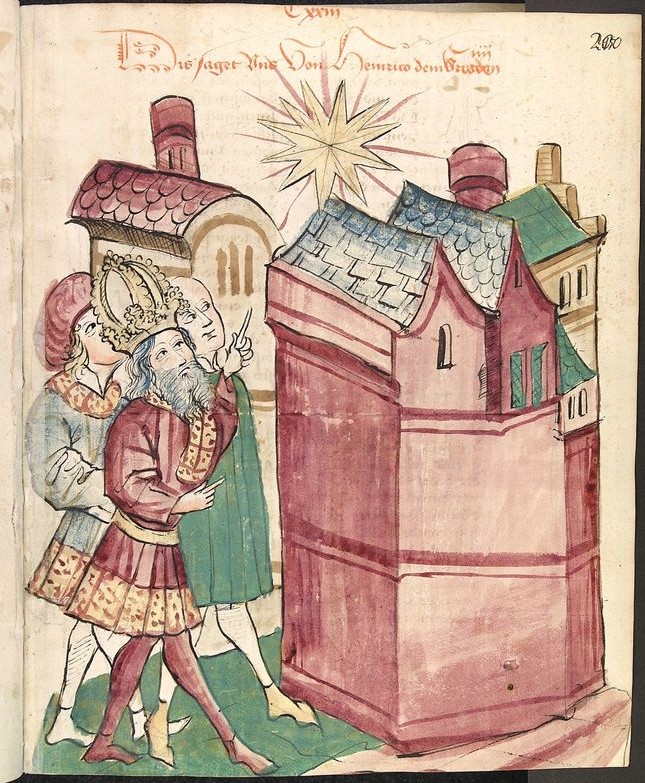
Fol. 200r
Miniature from the Lauber workshop depicting Emperor Henry III pointing toward a newly appeared star above Tivoli.
Image: Miniature from the Chronicon pontificum et imperatorum depicting Emperor Henry III (1017-1056)12 observing the appearance of a ‘new star’ above the city of Tivoli, Italy. Produced in Hagenau around 1450 by the Lauber workshop (Diebolt). From Cod. Pal. germ. 149, fol. 200r.13
Image credit: Universitätsbibliothek Heidelberg, Bibliotheca Palatina, HeidICON Object #551868.
Caption adapted from: HeidICON – Universitätsbibliothek Heidelberg.
Available at: link. Accessed on: 8 Nov. 2025.
Two European texts are frequently discussed. The first appears in the Tractus de Ecclesia S. Petri Aldenburgensi, which describes a brilliant circular light in the sky at the moment of Pope Leo IX’s death on 14 April 1054:6
Tractus de Ecclesia S. Petri Aldenburgensi — report:
“And at the very hour of his (Pope Leo IX) passing, not only in Rome, where his body lay, but indeed throughout the whole Earth, a circle (circulus) of extraordinary brilliance appeared in the sky for the space of half an hour”
(STEPHENSON & GREEN, 2002b, p. 141)
However, this phenomenon is more plausibly explained as a solar halo or an auroral display, rather than a supernova.7
A second candidate is found in the Cronaca Rampona, compiled in Bologna around the fifteenth century, which reports a very bright star entering the circle of the new Moon:8
Cronaca Rampona — report:
“In the year of Christ 1058 (M18), Henry III had reigned 19 years. He first came to Rome in the month of May. At this time there was famine and death over the whole Earth. He occupied the state of Tiburtina for three days in the month of June … At this time a very bright star (stella clarissima) entered (ingressa est) into the circle of the new Moon (in circuitu prime lune) on the 13th day before the Kalends at the beginning of the night.”
(STEPHENSON & GREEN, 2002b, p. 141)
Some scholars attempted to reinterpret this entry as referring to SN 1054.9 Yet the passage closely parallels a nearly identical text in the Annales Cavenses under the year 1086, describing an occultation of Venus by the Moon:10
Annales Cavenses — report:
“1086. On the 13th day before the Kalends of March at the beginning of the night a very bright star (stella clarissima) entered (ingressa est) into the circle of the new Moon (in circulum lunae primum).”
(STEPHENSON & GREEN, 2002b, p. 141)
The resemblance raises the possibility that the Rampona chronicle may have derived from the Cavenses chronicle with a misdated entry, creating an illusion of an earlier observation, according to Stephenson and Green (2002b, p. 141).
In summary, no reliable European record of the 1054 supernova survives.11 As Stephenson and Green (2002b, p. 142) observe, the star may well have been seen in Europe – but if so, observers likely mistook it for a bright planet rather than identifying it as a ‘new star’.
Note: This text is adapted from my thesis (2025), with all sources duly cited.
References
- AL DALLAL, S.; AZZAM, W. J. A Brief Review of Historical Supernovae. International Journal of Astronomy and Astrophysics, v. 11, n. 1, p. 79, 2021. ↑
- AL DALLAL; AZZAM, 2021, p. 79. ↑
- STEPHENSON, F. R.; CLARK, D. H.; CRAWFORD, D. F. The supernova of AD 1006. Monthly Notices of the Royal Astronomical Society, v. 180, n. 4, p. 572-574, 1977. ↑
- COLLINS ET AL. (1999), cited in AL DALLAL; AZZAM, 2021, p. 79. ↑
- STEPHENSON, F. R.; GREEN, D. A. The SN of AD 1054. In: STEPHENSON, F. R.; GREEN, D. A. Historical Supernovae and their Remnants. Oxford: Oxford University Press, 2002b. p. 141-142. ↑
- STEPHENSON; GREEN, 2002b, p. 141. ↑
- STEPHENSON; GREEN, 2002b, p. 141. ↑
- STEPHENSON; GREEN, 2002b, p. 141. ↑
- WILLIAMS (1981), COLLINS ET AL. (1999), cited in STEPHENSON; GREEN, 2002b, p. 141. ↑
- STEPHENSON; GREEN, 2002b, p. 141. ↑
- STEPHENSON; GREEN, 2002b, p. 142. ↑
- ENCYCLOPAEDIA BRITANNICA. Holy Roman Empire – Origins of the empire and sources of imperial ideas. Britannica. 2025. Available at: link. Accessed on: 8 Nov. 2025. ↑
- UNIVERSITÄTSBIBLIOTHEK HEIDELBERG. Cod. Pal. germ. 149, fol. 200r. Heinrich III. sieht den neuen Stern über der Stadt Tivoli (Tyburtina). Hagenau, ca. 1450. Lauber-Werkstatt. Available at: link. Accessed on: 8 Nov. 2025. ↑