
Recent studies in archaeoastronomy suggest that certain rupestrian sites in Brazil may preserve visual echoes of the supernova of AD 1054.1 These hypotheses stem from recurring motifs that pair a crescent Moon with a luminous star-like figure, mirroring the astronomical configuration of early July 1054.2 Although the dating of these panels is uncertain and the symbolism of rock art is inherently polyvalent, the interpretations open a compelling window onto how Indigenous groups may have observed unusual celestial events.
1. Fonte Grande I (Bahia)
Archaeoastronomical studies at the Fonte Grande I site, in Bahia, propose that a painted motif showing a crescent Moon beside a bright circular form may represent the conjunction of the Moon with the supernova shortly after its first appearance.3
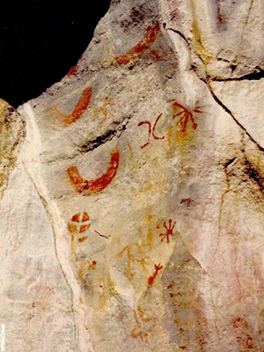
Image: Rock painting from the Fonte Grande I site (Bahia), proposed as a possible depiction of the conjunction between the crescent Moon and the supernova of AD 1054.
Image credit: De Nader & Jalles (2018). In: COSTA, 2022, p. 52.
Costa (2022, p. 52) notes that De Nader and Jalles (2018) proposed that one of the figures at the Fonte Grande I site represents the conjunction of the Moon with the supernova of AD 1054.
2. Toca dos Astros (Paraíba)
Another prominent case comes from the Toca dos Astros site in Paraíba, where paintings and engravings show motifs reminiscent of those at Chaco Canyon.4 A radiating five rayed star-like figure appears beside a crescent Moon, and further left, a semicircle with a central red dot.5
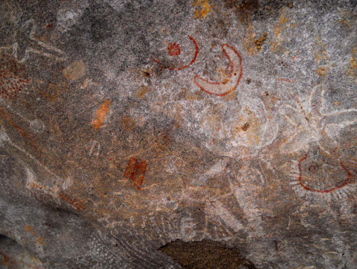
Image: Rock-art motifs interpreted as possible astronomical figures at the Toca dos Astros archaeological site (Congo, Paraíba).
Image credit: Dennis Motta Oliveira. In: COSTA, 2022, p. 53.
Costa (2022, p. 53) suggests that, since the star was visible for 623 nights and even in daylight for about 23 days, the panels may encode a sequence rather than a single moment of observation.6
3. Lagoa do Escuro (Paraíba)
A third proposed record comes from the Lagoa do Escuro site, also in Paraíba, where a crescent Moon is depicted alongside an eight-rayed star.7
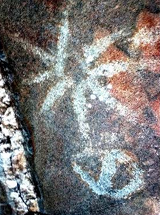
Image: Detail of a petroglyph at the Lagoa do Escuro archaeological site, possibly depicting the supernova of AD 1054 beside a crescent Moon.
Image credit: COSTA, 2022, p. 55.
Although this correlation is not definitive, it strengthens the hypothesis that the motif could represent a visual memory of the event, translated into the symbolic vocabulary of the region’s rock art.
While these Brazilian panels cannot be securely identified as depictions of the 1054 supernova, their recurring association of the crescent Moon with a prominent star-like figure offers intriguing possibilities. Within the limitations of dating and interpretation, these sites hint that Indigenous communities in northeastern Brazil may have observed and artistically registered one of the most famous supernovae.
Note: This text is adapted from my thesis (2025), with all sources duly cited.
References
- COSTA, Felipe Sérvulo Maciel. Interpretações arqueoastronômicas da supernova 1054 no sítio arqueológico Lagoa do Escuro e na Toca dos Astros. Revista Tarairiú, v. 1, n. 19, p. 44-58, 2022. ↑
- COSTA, 2002, p. 52-55. ↑
- COSTA, 2002, p. 52. ↑
- COSTA, 2002, p. 53. ↑
- COSTA, 2002, p. 53. ↑
- COSTA, 2002, p. 53. ↑
- COSTA, 2002, p. 54-55. ↑