The supernova of AD 1006 is regarded as the brightest stellar outburst ever recorded in human history.1 Reports of the ‘new star’ survive from Yemen2, Morocco (perhaps Spain), Egypt, Iraq,3 China, Japan, and several parts of mediaeval Europe,4 with a possible record from North America as well.5 The Persian polymath Ibn Sīnā (Avicenna) also described the phenomenon in Arabic.6 Few other ancient or mediaeval astronomical events left such a wide cross-cultural footprint.7
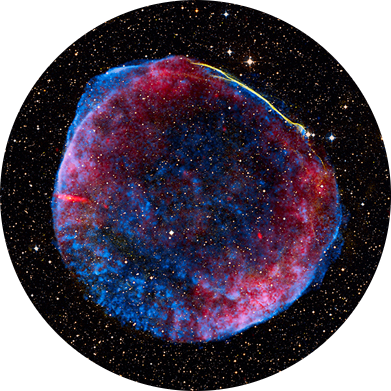
Image: A composite image of the spreading remnant of the supernova of AD 1006.14
Image credit: X-ray: NASA/CXC/Rutgers/G.Cassam-Chenai, J.Hughes et al.; Radio: NRAO/AUI/NSF/GBT/VLA/Dyer, Maddalena & Cornwell; Optical: Middlebury College/F.Winkler, NOAO/AURA/NSF/CTIO Schmidt & DSS.
Available at: link. Accessed on: 18 Nov. 2025.
This breadth makes SN 1006 a genuinely global phenomenon. Across continents and cultures, observers looked up at the same dazzling light in the constellation of Lupus,8 yet each community interpreted it through its own intellectual, religious, and scientific frameworks. Astronomers in the Islamic world, court scholars in East Asia, and European chroniclers all sought meaning in the extraordinary visitor to the night sky.
The first appearance of this supernova is dated around 30 April or 1 May 10069. However, some Islamic chronicles from Yemen (al-Yamanī and Ibn al-Daybaʿ) record an earlier first visibility around 17 April 1006, likely reflecting differences in latitude and observing conditions.10
The duration was extraordinary: the ‘guest star’ remained visible for many months, and in some traditions it was remembered for as long as three years.11 The period of most intense and widely attested brilliance spans approximately May to August 1006, when observers repeatedly emphasized its overwhelming radiance.12
In the subsections that follow, this page surveys the records region by region – from the Islamic world to East Asia, from Europe to North America – tracing how a single celestial event echoed across cultures and knowledge traditions.
Map: Approximate global observation sites of the AD 1006 supernova. Regions highlighted correspond to areas in present-day Egypt, Iraq, Yemen, Morocco, Iran (Persia), China, Japan, and Europe13, as well as a possible observation in North America (compiled from multiple scholarly sources; approximate locations based on historical sources; modern borders used for reference).
Note: This text is adapted from my thesis (2025), with all sources duly cited.
References
- AL DALLAL, S.; AZZAM, W. J. A Brief Review of Historical Supernovae. International Journal of Astronomy and Astrophysics, v. 11, n. 1, p. 76, 2021. ↑
- RADA, Wafiq; NEUHÄUSER, Ralph. Supernova SN 1006 in two historic Yemeni reports. Astronomische Nachrichten, v. 336, n. 3, p. 249-257, 2015. ↑
- GOLDSTEIN, Bernard R. Evidence for a supernova of AD 1006. The Astronomical Journal. American Astronomical Society, v. 70, n. 1, p. 105-114, 1965. ↑
- STEPHENSON, F. R. SN 1006: the brightest supernova. Astronomy & Geophysics, v. 51, n. 5, p. 5.27-5.32, 2010 ; STEPHENSON, F. R. ; GREEN, D. A. The SN of AD 1006. In: STEPHENSON, F. R.; GREEN, D. A. Historical Supernovae and their Remnants. Oxford: Oxford University Press, 2002a. pp. 151-163, 167-170. ↑
- THAN, K. Ancient rock art depicts exploding star. Space.com. 5 Jun. 2006. Available at: link. Accessed on: 18 July 2025. ↑
- NEUHÄUSER, R.; EHRIG-EGGERT, C.; KUNITZSCH, P. An Arabic report about supernova SN 1006 by Ibn Sīnā (Avicenna). Astronomische Nachrichten, v. 332, n. 8, p. 789-795, 2011. ↑
- STEPHENSON, F. R. 2010 ; GREEN, D. A.; STEPHENSON, F. R. The historical supernovae. In: Supernovae and Gamma-Ray Bursters. Berlin, Heidelberg: Springer, 2003a. p. 2. ↑
- AL DALLAL; AZZAM, 2021, p. 76. ↑
- STEPHENSON; GREEN, 2002a. p. 150-174. ↑
- RADA, Wafiq; NEUHÄUSER, Ralph. Supernova SN 1006 in two historic Yemeni reports. Astronomische Nachrichten, v. 336, n. 3, p. 249-257, 2015. ↑
- STEPHENSON, 2010, p. 5.29-5.30 ↑
- AL DALLAL; AZZAM, 2021, p. 77. ↑
- European observations are associated with records from regions that correspond to present-day Switzerland, Italy, Belgium and France. ↑
- CHANDRA X-RAY OBSERVATORY. Supernova 1006 (SN 1006). Chandra Photo Album, 2008. Available at: link. Accessed on: 18 Nov. 2025. ↑