The supernova of AD 1054 is among the most iconic stellar explosions in recorded history.1 Although not as dazzling as the extraordinarily bright supernova of AD 1006,2 its legacy endures because its remnant – the Crab Nebula – later became one of the best-studied objects in modern astrophysics.3 Historical testimony places its first appearance on 4 July 1054.4
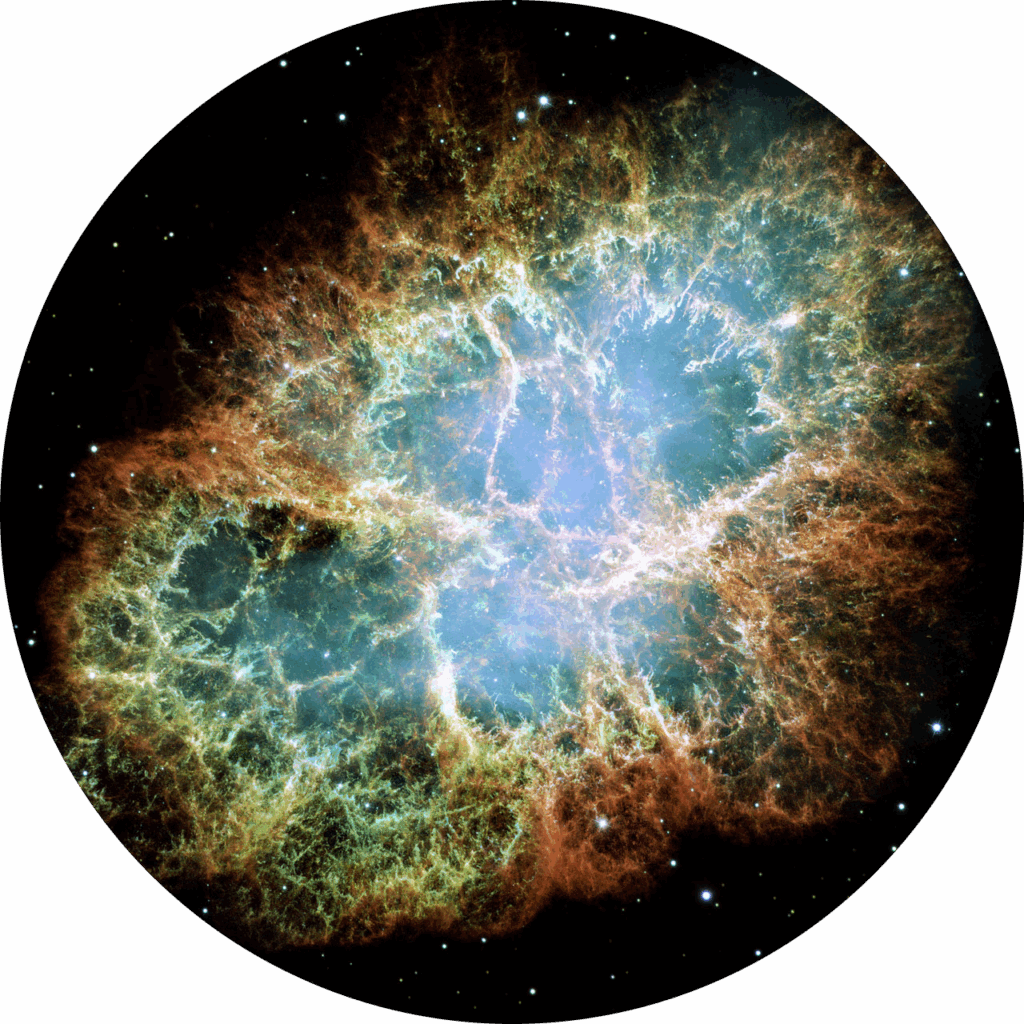
Image: High-resolution mosaic of the Crab Nebula (Messier 1) created from 24 exposures taken with the Hubble Space Telescope’s WFPC2 camera.9
Image credit: NASA, ESA, and Allison Loll & Jeff Hester (Arizona State University).
Caption adapted from: ESA/Hubble, ‘heic0515a’.
Available at: link. Accessed on: 7 Nov. 2025.
As with the supernova of AD 1006, the cultural breadth of the records of 1054 is remarkable.5 Reports survive from China, Japan, and the Islamic world, and – although debated – from mediaeval Europe, as well as possible references in North America6 and South America.7
The spectacle of SN 1054 was seen across continents and interpreted through distinct cultural frameworks – Confucian court astronomy, Islamic scientific scholarship, and possibly Christian monastic chronicle traditions and Indigenous sky-watching in the Americas. Each observer looked up at the same celestial visitor, yet every record reflects its own cosmology, its own anxieties, and its own interpretive habits.
In what follows, this page surveys the surviving testimonies region by region – from East Asia to the Middle East, Europe, and the Americas – tracing how this extraordinary event echoed across human history, memory, and scientific tradition.
Map: Approximate global observation sites of the AD 1054 supernova. Regions highlighted correspond to areas in present-day Egypt, China, Japan, as well as possible observations in Europe8, North and South Americas (compiled from multiple scholarly sources; approximate locations based on historical sources; modern borders used for reference).
Note: This text is adapted from my thesis (2025), with all sources duly cited.
References
- AL DALLAL, S.; AZZAM, W. J. A Brief Review of Historical Supernovae. International Journal of Astronomy and Astrophysics, v. 11, n. 1, p. 72, 2021. ↑
- STEPHENSON, F. R.; GREEN, D. A. The SN of AD 1054. In: STEPHENSON, F. R.; GREEN, D. A. Historical Supernovae and their Remnants. Oxford: Oxford University Press, 2002b. p. 117. ↑
- GREEN, D. A.; STEPHENSON, F. R. The historical supernovae. In: Supernovae and Gamma-Ray Bursters. Berlin, Heidelberg: Springer Berlin Heidelberg, 2003a. p. 6. ↑
- AL DALLAL; AZZAM, 2021, p. 72. ↑
- AL DALLAL; AZZAM, 2021, p. 78-80. ↑
- AL DALLAL; AZZAM, 2021, p. 72. ↑
- COSTA, Felipe Sérvulo Maciel. Interpretações arqueo astronômicas da supernova 1054 no sítio arqueológico Lagoa do Escuro e na Toca dos Astros. Revista Tarairiú, v. 1, n. 19, p. 44-58, 2022. ↑
- European observations are associated with records from regions that correspond to present-day Italy and Germany. ↑
- ESA/Hubble. Crab Nebula – heic0515a. NASA/ESA Hubble Space Telescope. Available at: link. Accessed on: 7 Nov. 2025. ↑