Among the recorded ‘guest stars’ of the Middle Ages, the one that appeared in AD 1181 was observed for about six months by Chinese and Japanese astronomers, described as a bright, steady star that slowly faded from view.1 Yet, despite the richness of these mediaeval records, its physical trace in today’s sky remained elusive for centuries.2
The first attempt to identify a physical remnant for the 1181 event pointed to the radio source 3C 58, located near the star SAO 12076 in the constellation Cassiopeia.3 Containing a pulsar (J0205+6449) and positioned within the region described in Chinese records, 3C 58 was firstly proposed by Stephenson (1971) as the most likely remnant of the explosion observed in 1181.4 For decades, this association remained the dominant interpretation in astronomical studies.5
However, modern radio studies later showed that 3C 58 is much older than expected – likely several thousand years old – making it incompatible with a twelfth-century event.6 Unlike the pulsar in the Crab Nebula, which has slowed down considerably since its explosion in 1054, the pulsar in 3C 58 shows little change, suggesting it was already ancient when first observed.7
A turning point came in the 2010s. In 2013, the amateur astronomer David Patchick discovered a faint, circular nebula – later named Pa 30 – whose unusual appearance drew scientific attention.8 Over the following years, several research teams investigated its characteristics, identifying an extremely hot, fast-wind central star later known as Parker’s Star.
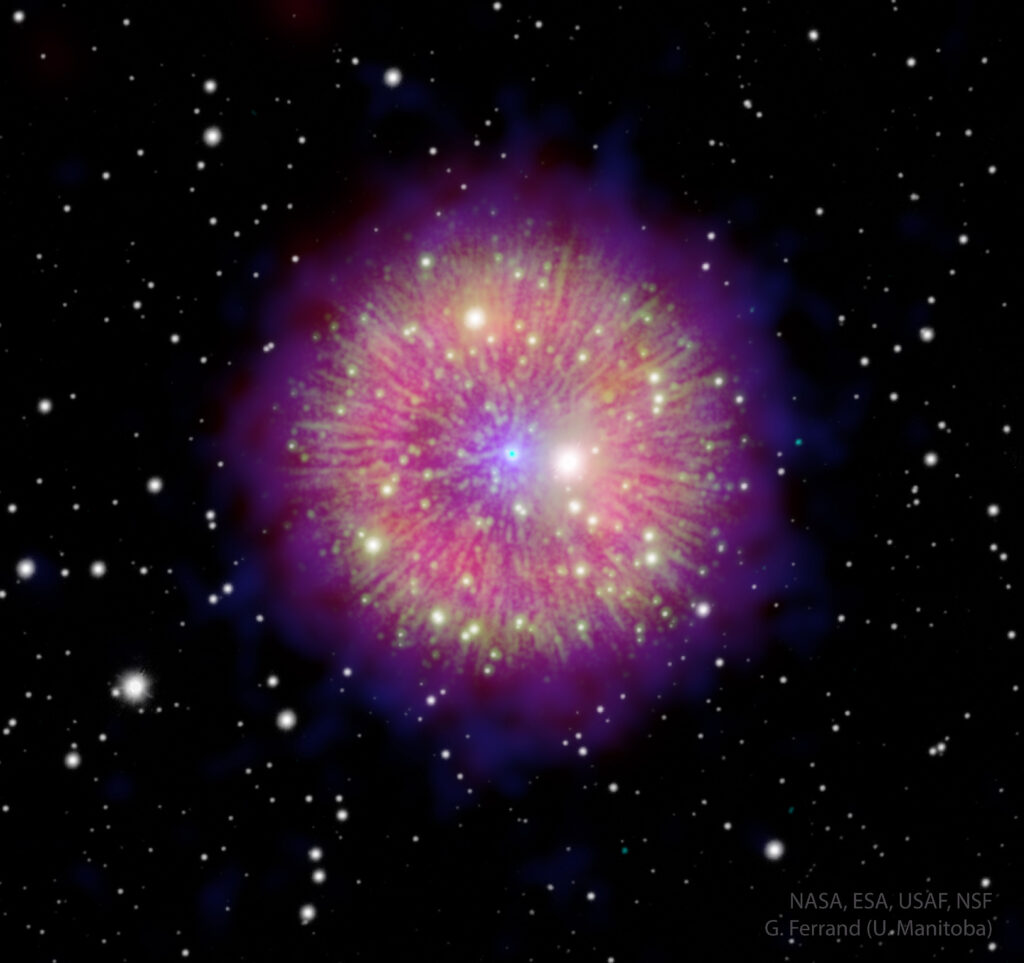
Image: Unusual Nebula Pa 3017.
Image credit: NASA, ESA, USAF, NSF; image processing by G. Ferrand, J. English, R. A. Fesen, and C. Treyturik (University of Manitoba, Dartmouth College).
Caption adapted from: Astronomy Picture of the Day (3 April 2024), original text by G. Ferrand & J. English.
Available at: link. Accessed on: 27 Oct. 2025.
It was found that Parker’s Star has a remarkable wind speed and chemical composition, consistent with the aftermath of a white-dwarf merger.9 Astronomers soon proposed that Pa 30 was created by the merger of two white dwarfs, producing a low-luminosity Type Iax supernova.10
According to Schaefer (2023), this sequence of discoveries gradually built the case for linking Pa 30 with the historical ‘guest star’, drawing also on earlier studies by Gvaramadze et al. (2019) and Oskinova et al. (2020).11 It was Ritter et al. (2021) who made the decisive link: by measuring the nebula’s expansion rate, they found that Pa 30 likely originated about 990 years ago – remarkably close to AD 1181.12
With these findings, the mystery surrounding SN 1181 gained a new explanation.13 Rather than 3C 58, the nebula Pa 30 stands as a most plausible candidate for the remnant of the medieval ‘guest star’. Its moderate brightness also matches the historical descriptions: in the Japanese Azuma Kagami, the star was said to shine “like Saturn” – steady, pale, and slightly yellow.14 Its absence from Korean, Arabic, and European records makes sense if the event was relatively dim and short-lived.15
The rediscovery of SN 1181’s remnant is more than an astronomical detective story. It also reflects a broader transformation in how humans relate to the sky. For mediaeval observers, this mysterious star was part of a cosmic language of signs – a possible omen in a universe filled with meaning.16 For modern scientists, it has become an astrophysical puzzle, decoded through data, modeling, and observation. Across these centuries, what has not changed is the same human impulse: to understand the lights of the heavens.
Note: This text is adapted from my thesis (2025), with all sources duly cited.
References
- STEPHENSON, F. R. A suspected supernova in AD 1181. In: International Astronomical Union Colloquium. Cambridge University Press, p. 10-12, 1971. ↑
- AL DALLAL, S.; AZZAM, W. J. A Brief Review of Historical Supernovae. International Journal of Astronomy and Astrophysics, v. 11, n. 1, p. 80, 2021. ↑
- GREEN, D. A.; STEPHENSON, F. R. The Historical Supernovae. In: WEILER, K. W. (ed.). Supernovae and Gamma-Ray Bursters. Berlin: Springer, 2003a, p. 5-6. ↑
- STEPHENSON, F. R. 1971. ↑
- STEPHENSON, F. R.; GREEN, D. A. The supernova of AD 1181: an update. Astronomy & Geophysics, v. 40, n. 2, p. 2.27-2.28, 1999. ↑
- AL DALLAL; AZZAM, 2021, p. 80. ↑
- AL DALLAL; AZZAM, 2021, p. 80. ↑
- SCHAEFER, B. E. The path from the Chinese and Japanese observations of supernova 1181 AD, to a Type Iax supernova, to the merger of CO and ONe white dwarfs. Monthly Notices of the Royal Astronomical Society, v. 523, n. 3, p. 3885-3886, 2023. ↑
- SCHAEFER, 2023, p. 3885-3886. ↑
- SCHAEFER, 2023, p. 3886. ↑
- SCHAEFER, 2023, p. 3886. ↑
- RITTER, Andreas et al. The Remnant and Origin of the Historical Supernova 1181 AD. The Astrophysical Journal Letters. American Astronomical Society, v. 918, n. 2, p. 2, 2021. ↑
- RITTER et al., 2021;
SCHAEFER, 2023. ↑ - STEPHENSON, F. R. 1971, p. 11. ↑
- GREEN; STEPHENSON, 2003a, p. 2. ↑
- STEPHENSON, 1971;
GREEN; STEPHENSON, 2003a. ↑ - FERRAND, G.; ENGLISH, J.; FESEN, R. A.; TREYTURIK, C. Unusual Nebula Pa 30. Astronomy Picture of the Day (APOD). NASA, ESA, USAF, NSF, 3 Apr. 2024. Available at: link. Accessed on: 27 Oct. 2025. ↑